


 netLex Vision
The amendment stopped being the slow point of the sale. Today legal moves at the pace of the commercial team and is recognized as a partner to the business.”
A business that grows in contracts
Gupy is one of Brazil's leading HR technology platforms, a reference in recruiting, selection and digital onboarding. Thousands of companies run on its products, and each of them generates contracts and a constant flow of amendments: new modules, price adjustments, scope changes.
For a business that grows like that, an amendment is not bureaucracy. It is revenue waiting for a signature. The legal contracts team is the gear between the closed deal and the signed contract. When the amendment stalls, the closing stalls with it.
Key points
- Amendments signed with no changes from the client jumped from 16% to 60%
- Amendment lead time fell 34%, from 38 to 25 days, from creation to signature
- Turnaround SLA dropped 80%, from 1.58 to 0.31 day
- 99.98% of steps completed within the deadline
The amendment was the slow point of the sale
For a long time, the amendment was where things stalled. Clauses were long and hard to read, which led clients to request changes at every round. Only 16% of amendments reached signature with no changes at all; the other 84% came back for adjustment, in a back-and-forth that consumed the team and pushed revenue further out.
The rest of the process followed that same rhythm:
- Each amendment took an average of 38 days from creation to signature;
- The average time for legal to return a document was 1.58 days;
- Every amendment was drafted manually, document by document, with no standardization;
The outcome was predictable: in practice, legal became the bottleneck of the closing — a department called in to unblock, not to accelerate.
Text, automation, governance and integration
The turnaround did not start with technology. It started with the text. Before automating anything, Gupy's team prepared the ground with four moves, in this order:
- Simplified clauses: The wording of the amendments was rewritten to be clearer and leaner, without unnecessary legalese. A clear document generates fewer doubts and fewer change requests from the client.
- Automatic generation in netLex: The amendment is now assembled from a standardized template, filled in automatically. Less human error, less drafting time.
- Structured workflow: Each step gained a defined owner and deadline, with a trail of who did what and when. Fewer rounds back and forth, SLA under control.
- Native Salesforce integration: netLex connected the sales CRM to the contract. The amendment is born from the opportunity and moves, in a single flow, from creation to signature — with no exporting data from one system to another.
It was that sequence: text, automation, governance and integration that turned the amendment from a slow point into a predictable process.
Results and impact
The data from the first months of operation confirms the change:
- The share of amendments signed with no changes from the client jumped from 16% to 60%. Put another way: rework fell from 84% to 40% of documents;
- Amendment lead time fell 34%, from 38 to 25 days, from creation to signature;
- The turnaround SLA dropped 80%, from 1.58 to 0.31 day, from nearly two days to a few hours;
- And 99.98% of steps are now completed within the deadline.
The Salesforce integration, in turn, stopped being a novelty and became the standard: within a few months, creation via the integration went from 4.5% to 53.8% of the monthly volume of amendments, and already accounts for 40.1% of everything created in the year.
By eliminating the back-and-forth between the sales CRM and the contract, it shortened the path from opportunity to signature — one of the reasons behind the shorter cycle.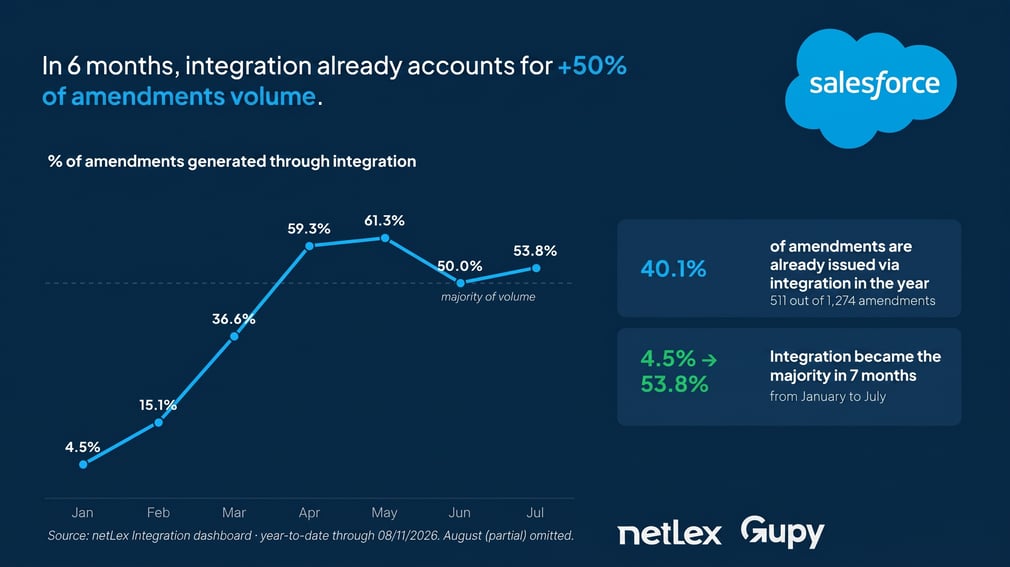
Beyond the numbers
The most important effect may be the one that does not fit in a chart. Less rework means a legal team with more time for what requires judgment. A shorter cycle means a sale that closes faster. A clearer document means a client who signs without friction.
The commercial team came to recognize legal as a concrete improvement in day-to-day work — no longer the bottleneck of the closing, but part of the engine that makes the business grow.
Before the process and the integrations, the flow required leaving the CRM, going into netLex, filling in a lot of data — rework and possible errors, on top of the operational bottleneck. Now it is all automatic and fluid: the steps were drastically reduced, the team gained speed. At month-end I feel it very strongly day to day, with cases closed at excellent speed. There is greater security thanks to fewer errors, and everything became centralized. The feeling today is that it is no longer a bottleneck step, but a process that enables the business.”
Legal as a partner to the business
At Gupy, the contract stopped being the point where the sale slows down and became part of the growth engine. That is what happens when legal takes on the role of business partner, with process, data and the right technology behind it.